

 Ever since I was a young boy, I could recall my fathers keen interest in history.
Among other things, he knew a lot about the Romans, not only from a Biblical context (what is written during the time of Jesus and the Apostles) but even from the period afterward. I enjoyed learning about different events and people, including how our people (Romanians) came to form a country. Long story short, the Romanian people trace their origins to the Roman Empire, specifically to the Roman conquest of the Dacian Kingdom in 106 AD. The Romans established the province of Dacia in what is now modern-day Romania, leading to significant Romanization of the local population. Over centuries, the intermingling of Roman settlers and native Dacians, combined with the influence of Latin language and culture, gave rise to the Romanian ethnicity and language, which is a Romance language directly descended from Latin. This historical connection is reflected in the country's name, Romania, which signifies its Roman heritage. As an adult, this is still one of my favorite people and time periods to study. We have a lot to learn from them. Good and bad. As we navigate the complexities of the 21st century, parallels between the decline of the Roman Empire and the current state of American society have become increasingly evident. From a Christian perspective, these similarities serve as a stark warning and a call to action. The degradation of moral values, political instability, economic challenges, and cultural decadence are eerily familiar. By examining these parallels through a Biblical lens, we can glean valuable insights and chart a course for national renewal. Historical and Cultural Parallels: Is it possible to live with no regrets?
Perhaps not completely. There will probably be those few things in life that you wished you would have done differently. Decisions. Actions. Spoken words. Relationships. Airbnb's you wished you wouldn't have rented (just seeing if you're still with me). And so on. But it is possible to live in freedom, because of Jesus! It's possible to look back after, to use my example, 20 years of marriage and boldly say, "God, you have been our refuge. Thank you for your faithfulness and grace, every step of the way." Here's a simple framework that we can (should) follow: 1) Repent and turn to God The greatest regret one can have is not surrendering to the Lord Jesus Christ. The saddest thing in the world is someone dying without knowing Jesus. If you're reading this today and are not born again, God is calling you to a new life! Reach out to us if you need help understanding what this Christian life is all about. For those who are saved, repentance is still a daily practice. It's a constant turning to the Father for strength and forgiveness. Acts 3:19 "Repent, then, and turn to God, so that your sins may be wiped out, that times of refreshing may come from the Lord." 2 Chronicles 7:14 "If my people, who are called by my name, will humble themselves and pray and seek my face and turn from their wicked ways, then I will hear from heaven, and I will forgive their sin and will heal their land." Isaiah 55:6-7 "Seek the Lord while he may be found; call on him while he is near. Let the wicked forsake their ways and the unrighteous their thoughts. Let them turn to the Lord, and he will have mercy on them, and to our God, for he will freely pardon." 1 John 1:9 "If we confess our sins, he is faithful and just and will forgive us our sins and purify us from all unrighteousness." 2) Fear God, not man Living in fear of man leads to a life of anxiety and compromise. This often stems from people pleasing. People-pleasing is when you prioritize making others happy or gaining their approval over being true to your convictions or doing what is right. It often involves going along with what others want, even if it goes against your own values or needs. Here's an example that's close to home, being that I'm in the HR field: If you agree to work extra hours every time your boss asks, even when you're exhausted and need rest, because you fear disappointing them or losing their approval, that's people-pleasing. This does not mean that we do not seek to live in peace with people and in such a way that we have harmony and wellbeing in our daily relationships (at work, church, in society, etc.). It means we are clear in our communication and do not compromise our faith, values, morals, and so on. Expect that some people will be bothered when they see you choosing to live this way versus bending to every request. At the end of life, I will give an account to God, not man, for all that I've done. Galatians 1:10 "Am I now trying to win the approval of human beings, or of God? Or am I trying to please people? If I were still trying to please people, I would not be a servant of Christ." Colossians 3:23-24 "Whatever you do, work at it with all your heart, as working for the Lord, not for human masters, since you know that you will receive an inheritance from the Lord as a reward. It is the Lord Christ you are serving." 1 Thessalonians 2:4 "On the contrary, we speak as those approved by God to be entrusted with the gospel. We are not trying to please people but God, who tests our hearts." Proverbs 29:25 "Fear of man will prove to be a snare, but whoever trusts in the Lord is kept safe." 3) Mind your own business and live a quiet life This alone would solve a lot of problems in the world. Don't be quick to meddle in the business and life of others. It doesn't mean not to be caring, loving, and even involved. But stay free from drama, envy, unforgiveness, bitterness, and gossip (I'm sure there's much more you can add to the list). 1 Thessalonians 4:11-12 "Make it your ambition to lead a quiet life: You should mind your own business and work with your hands, just as we told you, so that your daily life may win the respect of outsiders and so that you will not be dependent on anybody." Proverbs 17:27-28 "The one who has knowledge uses words with restraint, and whoever has understanding is even-tempered. Even fools are thought wise if they keep silent, and discerning if they hold their tongues." 1 Timothy 2:1-2 "I urge, then, first of all, that petitions, prayers, intercession and thanksgiving be made for all people—for kings and all those in authority, that we may live peaceful and quiet lives in all godliness and holiness." 2 Thessalonians 3:11-12 "We hear that some among you are idle and disruptive. They are not busy; they are busybodies. Such people we command and urge in the Lord Jesus Christ to settle down and earn the food they eat." Keep the Fire Burning, Danny A simple guide for parents so they can focus on 4 major lessons during the adolescence stage with their children. (Catered to boys but can be used for girls as well.) 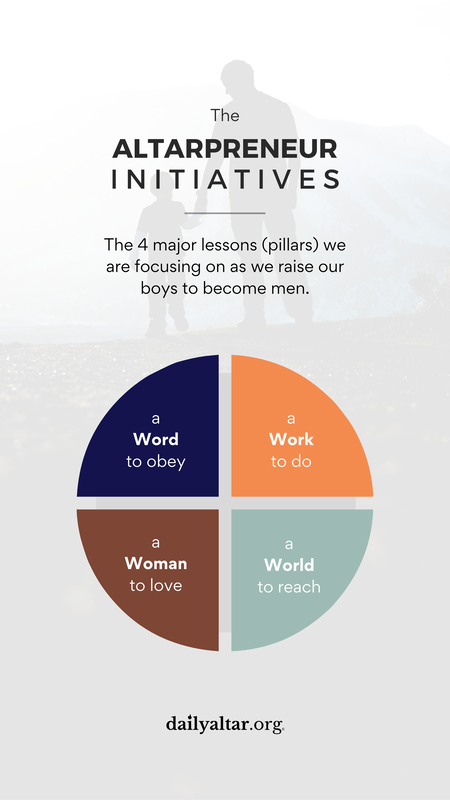  Lesson 1: Put aside distractions
“And when He had sent the multitudes away...” (Matthew 14:23) The multitudes, or crowds, are not necessarily a distraction, after all, Jesus ended up ministering to them. But they can be if they are a barrier to solitude. Put aside anything that will keep you from being alone with God. Jesus was intentional about His time with God. He didn’t wait until the crowds left. He didn’t ask the disciples to convince them to leave. He didn’t just avoid them and run off to a secret place. He sent the multitudes away. Most, if not all, of us know what the multitudes are in our own lives; the thing(s) we need to send away. Meet it head on. Any distraction, be it digital, physical, mental, emotional, vocational, financial, and so on, requires time. Where there is no investment of your time there is no opportunity for intimacy, or close connection. Distractions are a time-killer; therefore, they are an intimacy-killer. Have you heard of Parkinson’s Law? Parkinson’s Law is the adage that work expands to fill the time allotted for its completion. The term was first coined by Cyril Northcote Parkinson in a humorous essay he wrote for “The Economist” in 1955. He shares the story of a woman whose only task in a day is to send a postcard -- a task which would take a busy person approximately three minutes. But the woman spends an hour finding the card, another half hour looking for her glasses, 90 minutes writing the card, 20 minutes deciding whether to take an umbrella along on her walk to the mailbox…and on and on, until her day is filled. Let’s look at a modern example. You want to start your day with Bible reading and journaling. You plan to set aside, let’s just say, 15 to 20 minutes. But because you know you have enough time, and don’t plan to get into so much material, you get derailed. While you’re opening your Bible and finding the next blank page in your journal, you decide to pick up your phone. You tell yourself that you’ll check out some “inspirational” reels or the latest devotional from dailyaltar.org (shameless plug), but then you end up spending ten minutes watching behind the scenes videos about tiny houses, or reels with beautiful destinations in Italy, that you will probably never visit. Ultimately, the thing that should have been a delightful and focused effort turns into a I-shouldn’t-have moment. That’s Parkinson’s Law in action. {Excerpt from Daily Altar, 7 Disciplines of a Power Couple} |
ALTARPRENEURwith Danny & Daniela Kovacs

WHYNo family is an island. Join us as we share candid discussions, Biblical advice & resources to help keep God at the center of your faith, family and career. MICROBLOGS



Categories
All
Archives
July 2024

|
 RSS Feed
Us |
|
